



Bone Density After 50: 2 Things That Reversed My Osteopenia
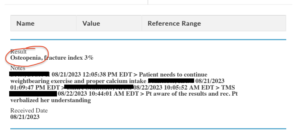
The slap that woke me up. Mine came with a word I had never heard before: osteopenia.
Published: August 2026 | Vital Blink
Bone density after 50 is not something you think about, until a number on a page forces you to. We seem to forget we are not bulletproof (especially when we are younger).
I remember my dad when we went skiing. He was probably in his late 60s, and he had gained weight and was sedentary for the most part. Although he used to be a very good skier, he wanted to do the double black diamonds with me the way we used to, and his body was not keeping up with him anymore. He fell and had a concussion. Thankfully, he recovered.
That was the slap that woke me up. The one that tells you “I ain’t as good as I once was…” as Toby Keith wrote a whole song about that feeling.
For me, well, I had heard that one of the effects of menopause is losing bone density, and I had seen elderly women, especially the ones who looked, in my opinion, too slim and fragile, with what my mom explained to me was osteoporosis. Basically, your bones get weak and brittle.
I was not worried about it, because after a scan in my late 40s, I was told I had the bones of a 30 year old.
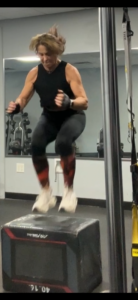
Fast forward a decade. I was feeling other effects of menopause, so I asked to have my hormones and I started HRT, the pills. I started lifting weights and started doing my jumps.
I did not just accept it.
I went to talk to my doctor about my hormones, and I started HRT, the pills. I started lifting weights and started doing my jumps.
I just got my new bone density scan, and it came back normal. I am more than ecstatic.
What Actually Happens to Bone Density After 50
Bone is not fixed once you reach adulthood. It is constantly being broken down and rebuilt, a process regulated in large part by estrogen. When estrogen falls during and after menopause, the balance shifts. Bone breaks down faster than it rebuilds, and bone mineral density drops, sometimes quickly.
This is not rare. It is the ordinary physiology of this stage of life, which is exactly why a scan and a conversation with a doctor matter more here than almost anywhere else.
What Is Osteopenia?
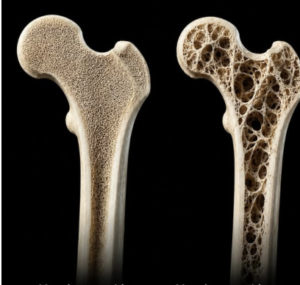
Osteopenia is a measurable reduction in bone mineral density that falls below the normal range but has not yet reached the threshold for osteoporosis. It is typically identified through a DXA scan, the same type of scan used to diagnose osteoporosis. Osteopenia is not a disease. It is a signal, and one that responds to intervention, particularly hormone support and resistance work.
The Research Behind HRT and Bone Density After 50
Hormone replacement therapy is not a new idea in bone health. It is one of the most studied interventions available for postmenopausal bone loss, and it is a prescription decision made with a doctor, not a self-directed one.
A 2021 network meta-analysis in the Journal of Clinical Medicine, covering 94 randomized controlled trials and 15,776 postmenopausal women, compared 11 different treatments for postmenopausal osteoporosis. HRT ranked first for improving distal radius bone mineral density and third for total hip bone mineral density, outperforming most other options studied (Lin et al., 2021).
Two honest caveats worth stating plainly. That study population was women already diagnosed with osteoporosis, not osteopenia specifically, so the match to an osteopenia diagnosis is close but not exact. I also could not confirm this particular review was pre-registered before it began, which is a transparency detail worth knowing even though nothing in the data itself was contradicted or retracted.
Resistance Training and Bone Density After 50: Where It Works, and Where It Falls Short
Hormones are half the picture. Movement is the other half, and the research on this is specific about what works and what does not.
A 2023 network meta-analysis in Frontiers in Physiology, covering 19 randomized controlled trials and 919 postmenopausal women, found that moderate intensity resistance training, three days a week for up to 48 weeks, produced measurable improvement in lumbar spine bone mineral density and femoral neck bone mineral density compared to no training at all (Wang et al., 2023).
The same review found no significant improvement at the hip or trochanter. Resistance training builds bone density in a site-specific way. It is not a universal answer, and pretending otherwise would not serve you. What the research supports is real: lift, and specific bones respond.
If you want the fuller picture on how resistance work changes your body after 50, this piece on resistance training after 50 goes deeper into the muscle and bone research.
[ IMAGE HERE ] Woman 50+ mid-jump or lifting, real gym, real effort. | Alt text: “Resistance training for bone density after 50” | Caption: Lifting heavy is not optional after menopause. It is structural.
My Perspective
I did not think much about bone density after 50 until a piece of paper made me. I think about my
dad on that mountain more than I expected to. He did not get a warning before his body stopped keeping up with him. I got one, on a piece of paper with a word on it I had never heard before.
The notes on that first scan actually told me what to do next. Continue weight-bearing exercise. I just had to decide to actually do it.
I did not choose HRT or lifting or jumping because I found a program online. I chose them because both came up, directly, in the same conversation where I learned the word osteopenia. Hormones and movement. Both, not one.
I cannot change that estrogen falls after menopause. I can change what I do about it.
Frequently Asked Questions
What is osteopenia?
Osteopenia is a reduction in bone mineral density that is lower than normal but not yet low enough to be classified as osteoporosis. It is diagnosed through a DXA scan and is most common after menopause, when falling estrogen shifts the balance between bone breakdown and bone rebuilding.
Why does bone density change after menopause?
Estrogen helps regulate the ongoing cycle of bone breakdown and rebuilding. When estrogen falls sharply during menopause, bone breaks down faster than the body rebuilds it, which lowers bone mineral density, sometimes within just a few years.
Can osteopenia be reversed?
Individual results vary, but bone density loss is not automatically permanent. In this case, a scan showing osteopenia returned to a normal reading after starting hormone replacement therapy and consistent resistance training. Research supports both HRT (Lin et al., 2021) and resistance training (Wang et al., 2023) as among the most effective interventions studied for bone density after 50.
Does resistance training alone improve bone density everywhere?
No. Research shows resistance training meaningfully improves bone mineral density at the lumbar spine and femoral neck, but the same studies found no significant effect at the hip or trochanter. The benefit is real and site-specific, not universal.
Should I get a bone density after 50 scan?
If you are in perimenopause or postmenopause and have not had one, it is worth asking your doctor about a DXA scan, particularly alongside a hormone panel. A single scan is what turned this from an assumption into an actual number for me.
Want the real research behind building capacity after 50, not just this one?
Ready for the next step? Get early access to Calm Energy, our first signature formula.
Sources: Lin SY, Hung MC, Chang SF, Tsuang FY, Chang JZC, Sun JS. Efficacy and Safety of Postmenopausal Osteoporosis Treatments: A Systematic Review and Network Meta-Analysis of Randomized Controlled Trials. Journal of Clinical Medicine. 2021;10(14):3043. pubmed.ncbi.nlm.nih.gov/34300210 | Wang Z, Zan X, Li Y, Lu Y, Xia Y, Pan X. Comparative efficacy different resistance training protocols on bone mineral density in postmenopausal women: A systematic review and network meta-analysis. Frontiers in Physiology. 2023;14:1105303. doi.org/10.3389/fphys.2023.1105303 | Note: Verify all PubMed links before publishing.