



Published: August 2026 | Vital Blink
What Is Brain Fog, Exactly?
Nine familiar symptoms, and the four systems actually behind them.
I have great intentions. I start my day looking at my calendar, writing down all the things that have come to mind that I need to get done. Great first step, right?

If only I could stick to the plan.
One of the things on the list the other day was to read a study on 900 women going through menopause. I kept jumping around, getting up to finish something else. I even say it to myself. Why am I postponing this? I know I have a deadline.
Regardless of my best efforts, I got to the end of the day feeling like I hadn’t gotten anything done. That can be both frustrating and cause me anxiety.
I did get around to reading it the next day. Sixty eight percent of those women reported brain fog. And I sat there thinking, oh. So this is what I have been calling ADD or ADHD. Women present their ADHD symptoms very differently from men. Given my stage of life, this jumping around is most probably brain fog.
So what is brain fog, actually?
What Is Brain Fog?
Brain fog is a term for mental confusion, sluggishness, and lack of clarity. It is not a medical condition on its own. It is a description of what happens when something else, hormonal, nutritional, or related to sleep and stress, affects executive function and processing speed. That is why it rarely shows up as one clean symptom and usually arrives as a mix.
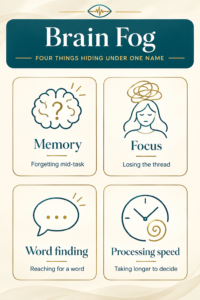 Nine words get used for it most often: difficulty concentrating, confusion, fatigue, forgetfulness, losing your train of thought, mental exhaustion, not having the right words, a slower thought process, and trouble paying attention.
Nine words sound like nine problems. They are not. Researchers group them into four systems, and knowing which one you are dealing with is what makes brain fog workable instead of just a feeling you tolerate.
The Four Systems Behind the Nine Symptoms
Each of the nine words maps onto one of four things researchers can actually measure:
- Memory. Forgetfulness and losing your train of thought both come from working memory, the ability to hold something in mind while you do something else.
- Focus. Difficulty concentrating, trouble paying attention, and mental exhaustion all point to sustained attention, staying on one task without drifting off it.
- Word finding. Not having the right words is its own category, a delay in retrieving a specific word you already know.
- Processing speed. Confusion, fatigue, and a slower thought process usually trace back to processing speed, how quickly you take in and respond to something in front of you.
This is why brain fog feels different from day to day. You are not imagining a new symptom each time. You are noticing which of the four systems is under the most load that day.
Why This Shows Up More After Menopause
In a survey of 900 women going through the menopause transition, 68.3 percent reported brain fog, 66.8 percent reported fatigue, and 63.9 percent reported difficulty concentrating (Post Reproductive Health, 2022). The numbers sit within four points of each other because they are largely describing the same shift from different angles.
Estrogen regulates the brain chemistry behind memory and processing speed. It increases the release of acetylcholine in the hippocampus, the brain’s memory center, and supports the neurons that produce dopamine, tied to focus and drive (Russell, Jones, and Newhouse, Neurotherapeutics, 2019). When estrogen drops during the menopause transition, that regulation changes.
Separately, PET imaging shows that after menopause, cerebral glucose metabolism, how efficiently the brain uses glucose for fuel, measurably drops in the regions responsible for memory and language retrieval (Mosconi et al., Scientific Reports, 2021). The same research found that ATP production actually rose in response, evidence the brain is compensating for a less efficient glucose pathway, not producing less energy overall.
Put together: the chemistry that regulates memory and focus changes, and the fuel pathway that powers those systems becomes less efficient at the same time. That combination is a plausible explanation for why brain fog clusters so tightly around this stage of life. It is physiology, not a personal failing.
My Perspective
I used to call my version of this my ADD. Multi-tasking that used to move me forward now just scatters me. Once I saw the four systems underneath the nine words, I stopped trying to push through a vague feeling and started paying attention to which one was actually failing that day. Some days it is word finding. Other days it is processing speed. Naming it precisely is what let me do something about it, instead of just tolerating it.
Frequently Asked Questions
What is brain fog?
Brain fog is a term for mental confusion, sluggishness, and lack of clarity. It is not a medical diagnosis on its own. It describes what happens when an underlying factor, often hormonal, affects memory, focus, word retrieval, or processing speed.
Why does brain fog happen during menopause?
Estrogen regulates brain chemicals tied to memory and focus, and its decline during menopause changes that regulation. Research also shows the brain’s glucose fuel pathway becomes less efficient after menopause, which together may explain why brain fog is so common at this stage.
Are brain fog and ADHD the same thing?
No. ADHD is a diagnosed condition with its own criteria. Brain fog is a descriptive term, not a diagnosis. Some women notice their brain fog resembles ADHD symptoms, especially since women often present ADHD differently than men, but the two are not interchangeable.
What can I do about brain fog?
Start by noticing which of the four systems, memory, focus, word finding, or processing speed, is most affected and when. Rule out ordinary causes like poor sleep, dehydration, and low B12 or vitamin D first. If the timing lines up with your transition, that is worth raising with your doctor.
Join the Vital Blink Founders List
Ready for the next step? Get early access to Calm Energy, our first signature formula.
Related: Forgetting Words During Menopause: The 3 Real Brain Chemicals Behind It
Sources:
Post Reproductive Health. Survey of perimenopausal women, 2022. PMC9244939. https://pmc.ncbi.nlm.nih.gov/articles/PMC9244939/
Russell JK, Jones CK, Newhouse PA. “The Role of Estrogen in Brain and Cognitive Aging.” Neurotherapeutics. 2019;16(3):649-665. DOI: 10.1007/s13311-019-00766-9
Mosconi L, et al. “Menopause impacts human brain structure, connectivity, energy metabolism, and amyloid-beta deposition.” Scientific Reports. 2021;11:10867. DOI: 10.1038/s41598-021-90084-y
Note: Verify all PubMed links before publishing.