

0-Published: October 2026 | Vital Blink
Grip Strength for Women Over 50: What Your Hands Say About the Years Ahead
A boat, a jar of yellow peppers, and a study of 5,472 women that changed what I do with my hands.
15 years ago, a boat pulled me up out of the water on a slalom ski. I had done it so many times that it felt like nothing. I would pop right up.
A couple of years later, with no signs that something had changed, what popped open were my hands. The boat just yanked the rope right out of my hands… over and over again. It almost drown me.
I was still strong and looked fit. My grip was gone.

The Jar of Yellow Peppers
the next clue was that opening jars just got harder and harder. Then was this one jar of yellow peppers that I really wanted to add to my salad and I just could not open. So I changed the salad from greek to just mixed.
For years I just accepted these moments. A lid that would not turn, hands that would not hold on. I thought it was just part of the process of this new stage.
Then I started reading about why grip strength matters, and what I read about longevity made me curious enough to keep going. The more I read, the more I saw what grip could actually mean: independence, and catching myself by grabbing onto something when I slip.
Being the daughter, sister, and mother of medical researchers means I do not take a headline at face value. So I went to the studies.
What Is Grip Strength, and Why Do Researchers Measure It?
Grip strength is the squeeze that was missing when the rope left my hands, and when the lid of that jar would not turn.
Researchers measure it with a handheld device you squeeze with your dominant hand, and they count it in kilograms. It is quick, it needs no lab, and it gives them a read on your overall strength, not only the strength in your hands.
What the Research Shows About Grip Strength and Longevity
The study that stayed with me most was published in February 2026 in JAMA Network Open. Researchers followed 5,472 women between the ages of 63 and 99 for an average of about eight years. During that time, 1,964 of them died (LaMonte et al., JAMA Network Open, 2026).
The researchers split the women into four groups by grip strength in the dominant hand. The weakest group squeezed below 14 kilograms, about 31 pounds. The strongest group squeezed above 24 kilograms, about 53 pounds.
The women in the strongest group had a lower risk of dying than the women in the weakest group. After accounting for age, race and ethnicity, education, weight, smoking, alcohol, blood pressure, and other health conditions, that risk was 33 percent lower (hazard ratio 0.67, 95% confidence interval 0.58 to 0.78).

The part I kept rereading came next. The women wore an accelerometer on the hip for seven days, which measured how much they sat and how much they moved. The researchers added that to the analysis, and the strongest group still had a 30 percent lower risk (hazard ratio 0.70, 95% confidence interval 0.61 to 0.82). The pattern also held when they accounted for walking speed.
That tells you grip strength carried information of its own, beyond how active someone was. The study was funded by the National Institutes of Health, which matters to me when I decide how much weight a study deserves.
I want to be clear about the limits. This was an observational study, so it shows an association, not proof that raising your grip strength lengthens your life. What it gives you is a reason to pay attention to something you probably never think about.
Grip Strength and Brain Health: A Question Researchers Are Asking
Longevity was not the only thing I wondered about. I wanted to know whether grip had anything to do with the brain.
A 2022 paper in GeroScience pulled together a new Finnish group and 16 earlier studies. People in the top third for grip strength had a lower risk of dementia than people in the bottom third (hazard ratio 0.73, 95% confidence interval 0.62 to 0.86). The researchers also rated the overall certainty of that evidence as low to very low, and the Finnish group on its own did not reach statistical significance (Kunutsor et al., GeroScience, 2022).
So I treat this as a question and not an answer. I have not found a study of women only that answers it. If you want the part of brain health I can speak about with more confidence, I wrote about the neurological side of this stage of life here, and resistance work is the thread that connects it to grip, in this piece on resistance training after 50.
How to Improve Grip Strength at Home and at the Office
One thing before the list. The study measured grip strength. It did not test any of the habits below, so I am sharing them as common practice, not as proven treatments. They are small on purpose, and you can fold each into a day you already have.
At home
- Carry it in one trip. Hold a full grocery bag in each hand, or a water jug, or a pair of weights, stand tall, and walk for 30 seconds before you set them down. This is a farmers walk, and it is the one I would start with.
- Hang from a sturdy bar. If you have a pull-up bar and your shoulders feel good, hang for 10 seconds, rest, and do it twice. Keep your feet on a low step if you want to take some of your weight.
At the office
- Squeeze during a call. Roll a hand towel tightly, or hold a tennis ball, and squeeze hard for five seconds, then let go. Ten squeezes in each hand.
- Pinch a book. Hold a thick book or a stack of paper between your thumb and fingers at your side for 15 seconds. Switch hands.
- Take the heavy bag yourself. Carry your laptop bag or a box in one hand, then switch to the other halfway down the hall.
If you have pain in your wrists, hands, or shoulders, check with your doctor before you start. Wherever you are right now is a valid place to begin, and one carry of 30 seconds counts.
My Perspective
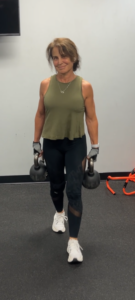
I do farmers walks now. Two weights, one in each hand, and I walk. Grip is no longer just the end of my arm. It is the part that decides whether I can hold on when I need to.
I still think about the boat sometimes. My hands opened, and I did not know why. Now I know a little more, and I would rather be working on it than wondering about it.
Each small choice adds capacity, and a 30-second carry is one of them.
Frequently Asked Questions
What is a good grip strength for women over 50?
There is no single cutoff, because published norms vary by age and method. In a 2026 study of 5,472 women aged 63 to 99, the weakest quarter squeezed below 14 kilograms (about 31 pounds) and the strongest quarter above 24 kilograms (about 53 pounds) in the dominant hand (LaMonte et al., JAMA Network Open, 2026).
Is grip strength linked to how long you live?
In that same study, women in the strongest grip group had a 30 percent lower risk of dying over about eight years than women in the weakest group, even after accounting for how much they moved. It is an observational study, so it shows an association and does not prove that building grip extends life.
Is grip strength connected to brain health?
Researchers are asking this question. A 2022 analysis found stronger grip linked to lower dementia risk (hazard ratio 0.73), but the authors rated the certainty of the evidence as low to very low, so it is early (Kunutsor et al., GeroScience, 2022).
How can you improve grip strength at home?
Common practice includes farmers walks with grocery bags, water jugs, or weights for about 30 seconds, and hanging from a sturdy bar for 10 seconds. These habits were not tested in the study above. Check with your doctor first if you have wrist, hand, or shoulder pain.
What is a farmers walk?
A farmers walk is carrying a weight in each hand while you walk with tall posture, usually for 30 to 60 seconds. It works your grip, your shoulders, and your core together.
Comment BLINK for 25% off your first order.
Sources: LaMonte MJ, Hyde ET, Nguyen S, et al. Muscular Strength and Mortality in Women Aged 63 to 99 Years. JAMA Network Open. 2026. doi.org/10.1001/jamanetworkopen.2025.59367 | Kunutsor SK, et al. Handgrip strength and risk of cognitive outcomes: new prospective study and meta-analysis of 16 observational cohort studies. GeroScience. 2022. doi.org/10.1007/s11357-022-00514-6 | Note: Verify all links before publishing.