



The Healthspan Gap: Why Women Live Longer But Not Always Better
Four systems estrogen protects at menopause, and the one habit that protects all four.
Published: September 2026 | Vital Blink

My Nono, grandfather in Italian, was strong as an ox, energetic, and had such a lively voice and opinions, if I may note. Enough for you to open your eyes wide and think to yourself, best that I do not engage. He used to rally up all his six children, with spouses and grandchildren, to go spend the day out in the countryside. It was an every Sunday ordeal in the summer. When not out in the mountains, we were at his house very long lunch table and also very long “sobremesa” at the table after.
By the time Nono left us, my Nona had already gone through breast cancer twice. She moved slower. She seemed more sedentary. She was also quieter. Her cognitive abilities had declined.
Somehow, she outlived him for well over a decade. That is probably two decades in decline.
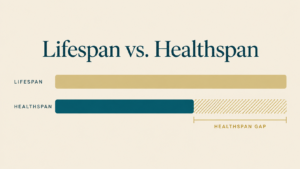
That decade has a name: the healthspan gap, the difference between how long we live and how many of those years we live in good health. The research says that gap runs wider for women than for men.
What the Healthspan Gap Actually Means
A 2024 analysis of 183 World Health Organization member states put a number on what I watched happen in my own family. Between 2000 and 2019, the global healthspan gap, the years lived with disease before death, reached 9.6 years. Women’s gap ran 2.4 years wider than men’s, a difference the researchers linked to a heavier burden of chronic disease carried by women specifically (Garmany and Terzic, JAMA Network Open, 2024).
Longer life was never the part in question. My Nona proved that on her own. The real question is what fills those extra years.
What Is the Healthspan Gap?
The healthspan gap is the difference between a person’s total lifespan and their healthspan, the number of years lived without significant disease or disability. A wider gap means more years spent managing poor health rather than living fully in it. Global data going back to 1995 shows this gap has grown for both sexes, and women consistently carry a wider gap than men.
One Hormone, Four Systems: Why the Healthspan Gap Happens
There is not a separate explanation for each part of what my Nona went through. There is one: estrogen. Estrogen receptors sit in muscle, bone, blood vessels, and brain tissue, and at menopause, all four lose a hormone that was doing real protective work at the same time.
In muscle, estrogen loss triggers cell-level apoptosis and weakens the processes that generate force. That is part of why postmenopausal women on hormone therapy show measurably greater muscle strength than those without it, in pooled data from nearly 10,000 women (Collins, Laakkonen, and Lowe, Bone, 2019).
In bone, estrogen normally restrains the cells that break bone down. Without it, resorption outpaces rebuilding (Weitzmann and Pacifici, Journal of Clinical Investigation, 2006), and the Endocrine Society reports women can lose up to 20 percent of bone density during the menopause transition and the years after, most of it in the first five to seven years. (More on building it back in our full breakdown of bone density after 50.)
In the cardiovascular system, estrogen supports healthy lipid levels and vascular function. A 2020 American Heart Association scientific statement found perimenopausal women twice as likely to have a lower overall cardiovascular health score than women still having regular cycles (Circulation, 2020).
And in the brain, estrogen regulates glucose uptake. After menopause, cerebral glucose metabolism measures lower in the regions tied to memory and language retrieval. The brain’s fuel system changes and has to work harder to produce the same output (Mosconi et al., Scientific Reports, 2021).
What Actually Closes the Healthspan Gap
One action touches all four systems at once: resistance training.

A 2025 systematic review and meta-analysis of 60 studies found that resistance training produced significant reductions in resting heart rate, systolic blood pressure, diastolic blood pressure, and mean blood pressure in postmenopausal women, along with improved cholesterol and triglyceride levels and no adverse effects on the heart (Journal of Applied Physiology, 2025). The same mechanical loading that lowers cardiovascular risk also builds muscle directly and stimulates the bone-building cells that estrogen loss leaves unchecked. Movement increases blood flow to the brain too, supporting the same glucose pathway that estrogen loss disrupts.
No single habit fully replaces what estrogen did. This is still the closest thing to one lever that works on muscle, bone, heart, and brain together, and it does not require a gym membership to start.
The Pillar That Is Not Physical
Muscle, bone, heart, and brain make up three quarters of the picture. Watching my Nono, the fourth quarter was never in question for him. Every Sunday, he rallied all six of his children, their spouses, and his grandchildren out to the countryside. That was not separate from his health. It was part of it.
Connection is not a soft add-on next to the physical work. It is its own pillar, and it deserves the same deliberate attention as the other three.
My Perspective
For me, closing the healthspan gap comes down to three things: strength to keep my mobility and independence, cognitive capacity to think clearly and be present, and nurturing the relationships that keep me connected to the people I love.
I cannot change my genetics or my family history. I can change what surrounds them, starting now, while there is still a full stretch of years ahead to build with.
Frequently Asked Questions
What is the healthspan gap?
The healthspan gap is the difference between a person’s total lifespan and their healthspan, the years lived without significant disease or disability. Globally the gap reached 9.6 years by 2019, and women’s gap runs 2.4 years wider than men’s (Garmany and Terzic, JAMA Network Open, 2024).
Why is the healthspan gap wider for women than for men?
Researchers link the wider female healthspan gap to a heavier burden of chronic disease across midlife and beyond. A major driver is estrogen loss at menopause, which affects muscle, bone, cardiovascular, and cognitive health at the same time, not separately.
Can you close the healthspan gap once it starts?
Yes. Resistance training is one of the few interventions shown to improve cardiovascular markers, muscle mass, and bone density together in postmenopausal women, with measurable results from a structured weekly practice (Journal of Applied Physiology, 2025).
Does menopause really affect the brain, not just the body?
Yes. Research using PET and MRI scans found cerebral glucose metabolism measurably lower after menopause in brain regions tied to memory and language, with estrogen loss proposed as the cause (Mosconi et al., Scientific Reports, 2021).
Is bone loss after menopause really that significant?
Yes. The Endocrine Society reports women can lose up to 20 percent of bone density during the menopause transition and the years that follow, with the fastest loss in the first five to seven years, driven by the loss of estrogen’s restraint on bone-resorbing cells.
Closing the healthspan gap takes more than one system working. Calm Energy supports the cellular side of it.
Ready for the next step? Get early access to Calm Energy, our first signature formula.
Sources: Garmany A, Terzic A. Global Healthspan-Lifespan Gaps Among 183 World Health Organization Member States. JAMA Network Open. 2024. DOI: 10.1001/jamanetworkopen.2024.50241 | Collins BC, Laakkonen EK, Lowe DA. Aging of the musculoskeletal system: how the loss of estrogen impacts muscle strength. Bone. 2019;123:137-144. DOI: 10.1016/j.bone.2019.03.033 | Weitzmann MN, Pacifici R. Estrogen deficiency and bone loss: an inflammatory tale. Journal of Clinical Investigation. 2006;116(5):1186-1194. DOI: 10.1172/JCI28550 | Endocrine Society. Menopause and Bone Loss. endocrine.org/patient-engagement/endocrine-library/menopause-and-bone-loss | Menopause Transition and Cardiovascular Disease Risk: Implications for Timing of Early Prevention. Scientific Statement from the American Heart Association. Circulation. 2020. DOI: 10.1161/CIR.0000000000000912 | Mosconi L, et al. Menopause impacts human brain structure, connectivity, energy metabolism, and amyloid-beta deposition. Scientific Reports. 2021;11:10867. DOI: 10.1038/s41598-021-90084-y | Resistance training improves cardiovascular health in postmenopausal women: systematic review and meta-analysis. Journal of Applied Physiology. 2025. DOI: 10.1152/japplphysiol.01180.2025 | Note: Verify all PubMed links before publishing.