

I Got Hit From Behind, After the Whistle Had Already Blown
The timing was not a coincidence. Stress does something measurable to focus, and the research is specific about what and why.
Published: July 2026 | Vital Blink
I got hit from behind, the way a soccer player takes a late shot after the whistle’s already blown.
Two years ago, a brand approached me to manufacture a product that wasn’t a good fit for my co-packing business. I’ve been specializing around the equipment I actually have, and this wasn’t it. I said no. They wouldn’t take no for an answer.

I offered to run one batch, just to help them get started. Instead, they came back with an incentive to get me to sign a three-year contract. I didn’t have the money for an attorney at the time. I believed in them, and that they would honor the spirit with which we wrote the agreement. Apparently their spirits have gone rogue.
I spent two years going above and beyond what the manufacturing part was, given that incentive, without making a profit, because that’s what it took to help them launch and grow.
Then I got a letter. They’re moving their business, no heads-up, calling it a “strategic decision” on their end. Strategic for them. Expensive for me.
I don’t like conflict. I’d rather be producing value. And this happened less than two weeks before the thing that actually matters right now: launching Calm Energy, my first product under this purpose-driven brand, my first time ever distributing through ecommerce.
This is an overload of stress. Even for my life coaching skills. I keep losing my focus. I catch myself stuck, replaying it, when I need to be especially sharp, while this old dog learns new tricks. I can’t tell you how important this launch is to me. Not as a career goal. This is living with purpose.
Why Stress Does Something Specific to Focus
What happened with that letter is a business problem. What happened in my head afterward is a brain problem, and there’s real research behind why the two got tangled together this fast.
The part of your brain that handles focus, planning, and filtering out distraction sits right behind your forehead. Under normal conditions, it keeps you deliberate: weighing, choosing, staying with a task even when something more urgent tries to grab your attention. Under sustained stress, that changes. Rising cortisol and norepinephrine weaken the connections that let this region do its job, and control shifts to faster, more reflexive parts of the brain built for react-first, think-later situations (Arnsten, Nature Reviews Neuroscience, 2009).
That shift is not a character flaw. It’s a chemical handoff, and it happens on a schedule set by how much cortisol is circulating, not by how much you want to concentrate.
What Is the Prefrontal Cortex?
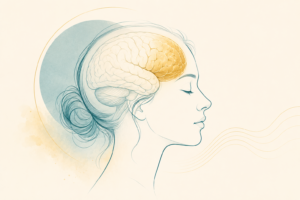
The prefrontal cortex is the region of the brain directly behind the forehead responsible for focus, planning, and impulse control. It works by filtering distraction and keeping reactive impulses in check. Under sustained stress, elevated cortisol and norepinephrine weaken its connections, shifting control to faster, more reactive brain regions (Arnsten, Nature Reviews Neuroscience, 2009).
Knowing this didn’t make the letter less unfair. It did explain why coaching myself through it, something I know how to do for other people, wasn’t fully working on my own brain in the moment.
What the Research Says Can Help
One compound shows up consistently in the research on attention specifically, not general brain health, attention: citicoline, a naturally occurring nutrient involved in building the membranes around neurons and supporting dopamine activity.
What Is Citicoline?
Citicoline is a compound the body uses to build phosphatidylcholine, a core component of neuron cell membranes, and to support dopamine signaling in the brain. It occurs naturally in the body and is also studied as a dietary supplement for its effects on attention and memory in adults.
In a randomized, double-blind, placebo-controlled trial of 60 women ages 40 to 60, those given 250 milligrams of citicoline daily for 28 days made significantly fewer attention lapses on a validated test of sustained attention, both missed responses (p = 0.04) and impulsive, before-you-think responses (p = 0.03), compared with placebo (McGlade et al., Food and Nutrition Sciences, 2012).
A separate pre-registered trial of 100 adults ages 50 to 85 found that 500 milligrams of citicoline daily for 12 weeks produced significant improvement in episodic memory (p = 0.0025) and overall composite memory score (p = 0.0052) compared with placebo (Nakazaki et al., Journal of Nutrition, 2021).

Two things worth knowing before drawing conclusions. Both trials were funded by the manufacturer of the citicoline used, and both used doses higher than what shows up in many supplement formulas: 250 and 500 milligrams. That gap matters. It means the research supports citicoline as an ingredient worth understanding for attention specifically, not a guarantee that every product containing it replicates these exact numbers.
This Is Not a Willpower Problem
Being a life coach did not make me immune to any of this. Expertise does not override chemistry. The prefrontal cortex responds to cortisol the same way whether you understand the mechanism or not.
What actually helps in the middle of it is smaller than people expect. Protecting sleep, because sleep is when cortisol resets. Reducing how many decisions you’re making in a day when you know one area is already draining your reserve. And paying attention to what the brain runs on at the cellular level, not just what you’re telling it to do.
None of that resolves the letter. It just means the version of me showing up for the launch is not also fighting her own brain chemistry on top of everything else.
My Perspective
I am writing this two weeks before the biggest launch of my career, in the middle of a fight I did not pick and cannot fully control. I have caught myself rereading that letter instead of finishing the task in front of me, more than once in the same afternoon.
Coaching skills get you partway. They do not override a prefrontal cortex that’s been chemically outvoted. What I’ve changed is not bigger willpower. It’s paying closer attention to what my brain runs on when the demand is this high: sleep first, then the cellular inputs that support attention instead of forcing it.
Calm Energy came out of that same question, asked over and over during the two years I spent building it. Not a way to push harder through a bad week. A way to make sure the fuel is there when the moment actually matters.
Frequently Asked Questions
Why does stress make it hard to concentrate?
Sustained stress raises cortisol and norepinephrine, which weaken the prefrontal cortex, the brain region responsible for focus and planning. This shifts control to faster, more reactive parts of the brain, making sustained attention measurably harder regardless of how motivated you are (Arnsten, Nature Reviews Neuroscience, 2009).
What is citicoline and what does it do?
Citicoline is a naturally occurring compound that helps build neuron cell membranes and supports dopamine activity in the brain. Clinical trials have studied it specifically for attention and memory, with doses of 250 to 500 milligrams daily showing measurable improvement over placebo in adults.
Can supplements actually help with stress-related focus problems?
Research on specific compounds like citicoline shows real, measurable effects at studied doses, but the evidence is dose-specific and should not be assumed to apply to every product. Sleep and reducing decision load during high-stress periods remain the foundation, with targeted nutritional support as an addition, not a replacement.
Is it normal to lose focus during a genuinely stressful life event?
Yes. Attention lapses under acute stress reflect a real, well-documented shift in brain chemistry, not a personal failing or lack of discipline. Expertise in managing stress for others does not make a person immune to the same chemical process happening in their own brain.
Is this the same as menopause brain fog?
Related but distinct. Menopause-related brain fog is tied to estrogen’s role in prefrontal and limbic system balance. Acute stress-driven focus loss is triggered by cortisol regardless of hormonal stage, though the two can compound each other. For more on the menopause-specific mechanism, see Brain Fog in Menopause: 5 Proven Reasons Your Brain Feels Different After 50.
Calm Energy™ launches soon.
Ready for the next step? Get early access to Calm Energy, our first signature formula.
Sources: Arnsten AFT. Stress signalling pathways that impair prefrontal cortex structure and function. Nature Reviews Neuroscience. 2009;10(6):410-422. doi:10.1038/nrn2648 | pmc.ncbi.nlm.nih.gov/articles/PMC2907136 | McGlade E, Locatelli A, Hardy J, et al. Improved attentional performance following citicoline administration in healthy adult women. Food and Nutrition Sciences. 2012;3(6):769-773. doi:10.4236/fns.2012.36103 | Nakazaki E, Mah E, Sanoshy K, Citrolo D, Watanabe F. Citicoline and memory function in healthy older adults: a randomized, double-blind, placebo-controlled clinical trial. Journal of Nutrition. 2021;151(8):2153-2160. doi:10.1093/jn/nxab119 | NCT03369925 | Note: Verify all PubMed/DOI links before publishing. Note: McGlade 2012 and Nakazaki 2021 were funded by Kyowa Hakko Bio Co., Ltd., manufacturer of the citicoline used in both studies.